AI-generated ICD-10 and CPT codes from clinical notes — Medical Coding Online
What Are DRG Codes?
A DRG (Diagnosis Related Group) is a classification that groups inpatient hospital cases expected to consume similar hospital resources. Each DRG has a fixed payment weight that Medicare multiplies by a base rate to determine reimbursement. The system was introduced in 1983 to replace cost-based reimbursement and incentivize efficiency.
- Over 750 MS-DRGs cover all possible inpatient stays
- Each DRG has a relative weight reflecting resource intensity
- Payment = DRG weight × hospital base rate × wage index adjustments
- Covers Medicare Part A inpatient hospital stays
- Updated annually by CMS in the IPPS final rule
MS-DRG vs APR-DRG vs AP-DRG
Several DRG systems are in use depending on the payer. Medicare uses MS-DRGs (Medicare Severity DRGs), while many commercial payers and Medicaid programs use APR-DRGs (All Patient Refined DRGs) developed by 3M.
| System | Developer | Used By | Severity Levels |
|---|---|---|---|
| MS-DRG | CMS | Medicare | 3 (no CC, CC, MCC) |
| APR-DRG | 3M | Medicaid, commercial | 4 (minor to extreme) |
| AP-DRG | 3M | Some state Medicaid | 3 |
| IR-DRG | 3M | International | Varies |
How DRGs Are Assigned
DRG assignment is determined by a grouper software that analyzes the coded claim. The principal diagnosis drives the MDC (Major Diagnostic Category), then procedures, CCs (complication/comorbidities), and MCCs (major CCs) refine the DRG. This is why clinical documentation improvement (CDI) is critical — vague documentation leads to lower-weighted DRGs.
- Step 1: Principal diagnosis → assigns MDC (1–25)
- Step 2: Procedures determine surgical vs. medical DRG partition
- Step 3: CCs and MCCs elevate the DRG weight
- Step 4: Age, discharge status, and sex apply in some DRGs
- Step 5: Grouper assigns final MS-DRG and payment weight
CC and MCC: The Key to DRG Optimization
Complications and Comorbidities (CCs) and Major Complications and Comorbidities (MCCs) are secondary diagnoses that increase DRG severity and reimbursement. Capturing all documented CCs and MCCs is the primary goal of clinical documentation improvement (CDI) programs.
- MCC examples: sepsis, respiratory failure, acute kidney injury (stage 3)
- CC examples: hypertension with CKD, malnutrition, anemia
- A single MCC can increase reimbursement by $3,000–$10,000+
- Must be documented by physician — coders cannot infer
- CDI specialists query physicians to capture missing CCs/MCCs
High-Value DRGs Every Hospital Coder Should Know
Certain DRGs carry significantly higher payment weights due to the severity and resource intensity of the cases they represent. Coders working in these areas should ensure all supporting diagnoses and procedures are captured.
| MS-DRG | Description | Avg Payment |
|---|---|---|
| 003 | ECMO or tracheostomy w/ MV 96+ hrs | $180,000+ |
| 207 | Respiratory system diagnosis w/ ventilator 96+ hrs | $75,000+ |
| 470 | Major joint replacement w/o MCC | $13,000+ |
| 871 | Septicemia w/ MV 96+ hrs | $50,000+ |
| 291 | Heart failure & shock w/ MCC | $18,000+ |
How AI Improves DRG Assignment
AI-powered coding tools analyze clinical documentation to identify all diagnoses and procedures, flag potential CCs and MCCs that may be under-documented, and suggest the most accurate DRG. This reduces revenue leakage from undercoding and audit risk from overcoding.
- Automatically extract all diagnoses from clinical notes
- Flag potential CCs/MCCs for CDI query
- Suggest ICD-10-CM codes that support higher-severity DRGs
- Cross-reference against official CC/MCC exclusion lists
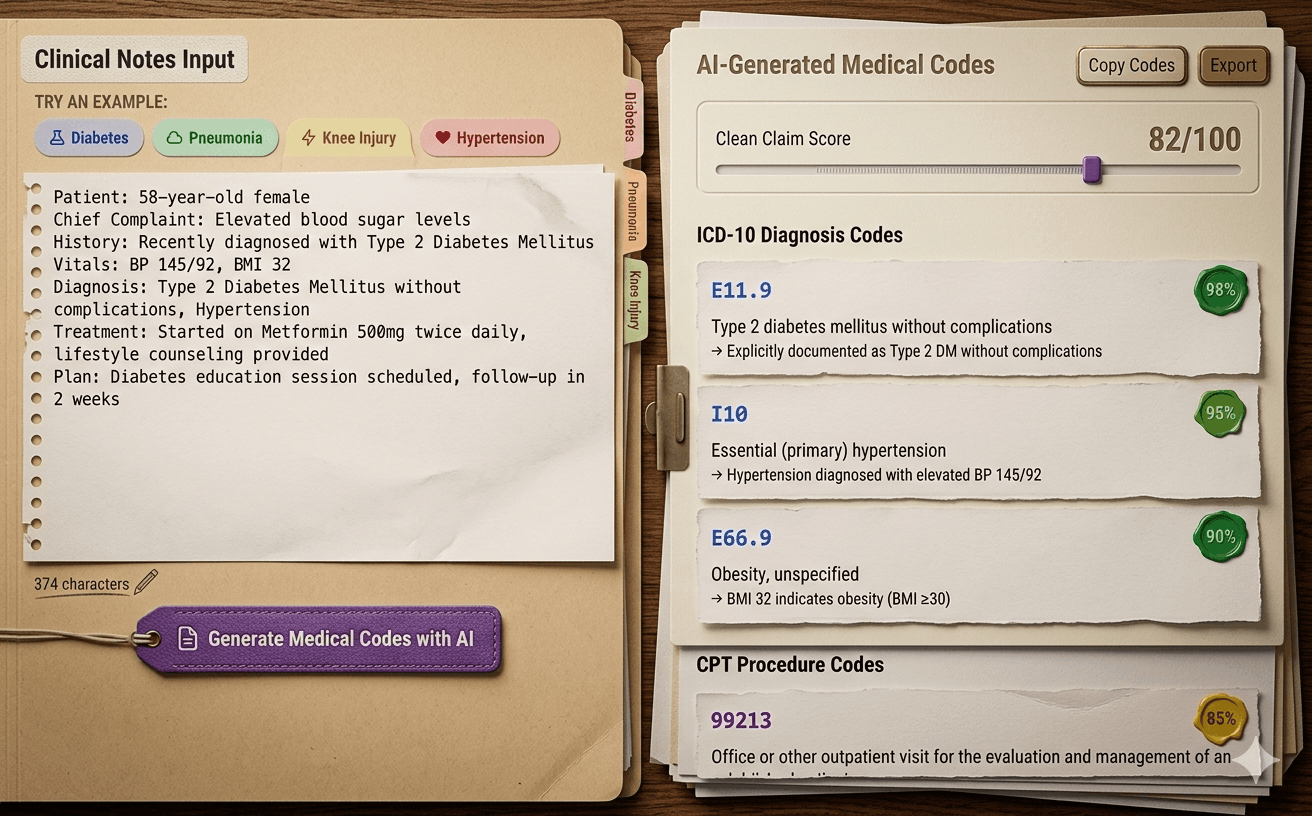
- Generate Clean Claim Scores before submission
- Reduce DRG validation time from hours to minutes
Frequently Asked Questions
- What is the difference between a CC and an MCC in DRG coding?
- A CC (Complication or Comorbidity) is a secondary diagnosis that increases the complexity of the hospital stay moderately, while an MCC (Major Complication or Comorbidity) represents a more severe condition that significantly increases resource use. MCCs result in higher DRG weights — and higher reimbursement — than CCs. Examples of MCCs include sepsis, respiratory failure, and acute kidney injury stage 3.
- How often are MS-DRGs updated?
- MS-DRGs are updated annually by CMS as part of the Inpatient Prospective Payment System (IPPS) final rule, typically published in August and effective October 1. Updates may add new DRGs, reclassify existing ones, or change CC/MCC designations for diagnosis codes.
- Can outpatient services use DRG codes?
- No. DRG codes apply only to Medicare Part A inpatient hospital admissions. Outpatient services use APCs (Ambulatory Payment Classifications) under the OPPS (Outpatient Prospective Payment System). Physician services are paid under the Medicare Physician Fee Schedule using CPT codes.
- What is a DRG grouper?
- A DRG grouper is software that analyzes a coded inpatient claim — including the principal diagnosis, secondary diagnoses, procedures, age, and discharge status — and assigns the appropriate MS-DRG. Hospitals use certified groupers to validate DRG assignments before claim submission.
- What triggers a DRG audit?
- Common DRG audit triggers include billing high-weight DRGs frequently without clinical justification, missing or vague physician documentation for CCs/MCCs, short stays billed as inpatient, and patterns flagged by CMS Recovery Audit Contractors (RACs). Accurate coding supported by complete clinical documentation is the best audit defense.