AI-Powered · ICD-10 · CPT · HCPCS

AI Medical Coding Assistant forICD-10, CPT & HCPCS

Automated ICD-10, CPT and HCPCS code mapping from clinical notes, in seconds.

Your Clinical Note

No PHI stored · 0/5000

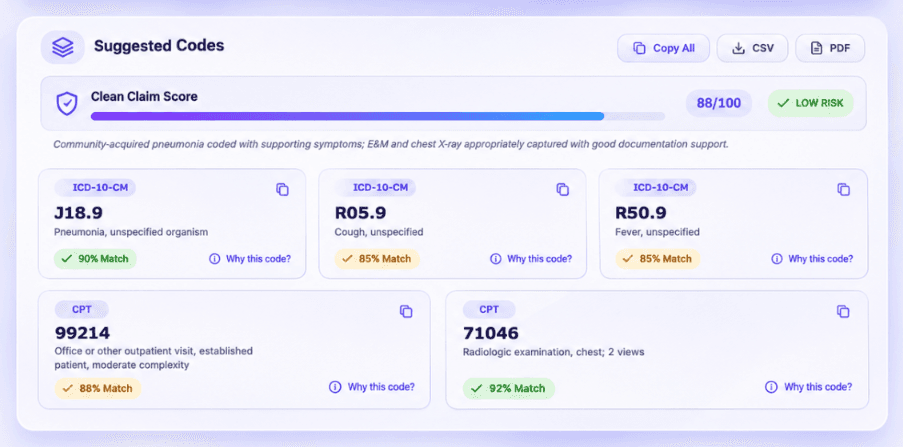
Suggested Codes

Example output, paste a note above and click Generate

ICD-10-CM
E11.22
Type 2 diabetes with diabetic CKD
ICD-10-CM
N18.31
Chronic kidney disease, stage 3a
CPT
99214
Office/outpatient visit, moderate complexity
Notes never storedICD-10-CM 2026CPT 2026

⚠ Disclaimer: AI-generated codes are for reference only. Verify with a qualified medical coder before billing submission.

Why Medical Professionals Choose Our AI Coding Tool

Seconds instead of the 15–30 minutes a chart takes by hand, with the coding-specific checks a general-purpose assistant does not do.

Confidence Scoring

Every code comes with a 0–100% confidence score. High-confidence codes are accepted quickly; lower ones are flagged for human review.

Denial Risk Detection

Scans each code set for denial triggers before you submit: mismatched pairs, missing specificity, NCCI edit conflicts.

Clean Claim Score

A composite 0–100 score predicting first-pass acceptance. Aim for 85+ before submission.

Rationale Explanation

Every code includes a plain-English rationale, useful for training, audits, and settling disagreements about a claim.

Multi-Diagnosis Support

Complex encounters with multiple diagnoses are handled in one pass, correctly sequenced per ICD-10 Official Guidelines.

Modifier Suggestions

Recommends CPT modifiers (-25, -51, -59, -LT, -RT) from the clinical context, cutting modifier-related denials.

How Medical Coding Online Works

Three steps. No training, no setup required.

1

Enter Clinical Notes

Copy and paste patient documentation, SOAP notes, or clinical narratives directly into our secure interface.

2

AI Analysis

The model reads the diagnoses, procedures and terminology in the note and works out which codes the documentation supports.

3

Review & Export

Get ICD-10, CPT, and HCPCS codes with confidence scores, denial risk alerts, and export options.

Medical Coding Online - AI-generated ICD-10 and CPT codes interface

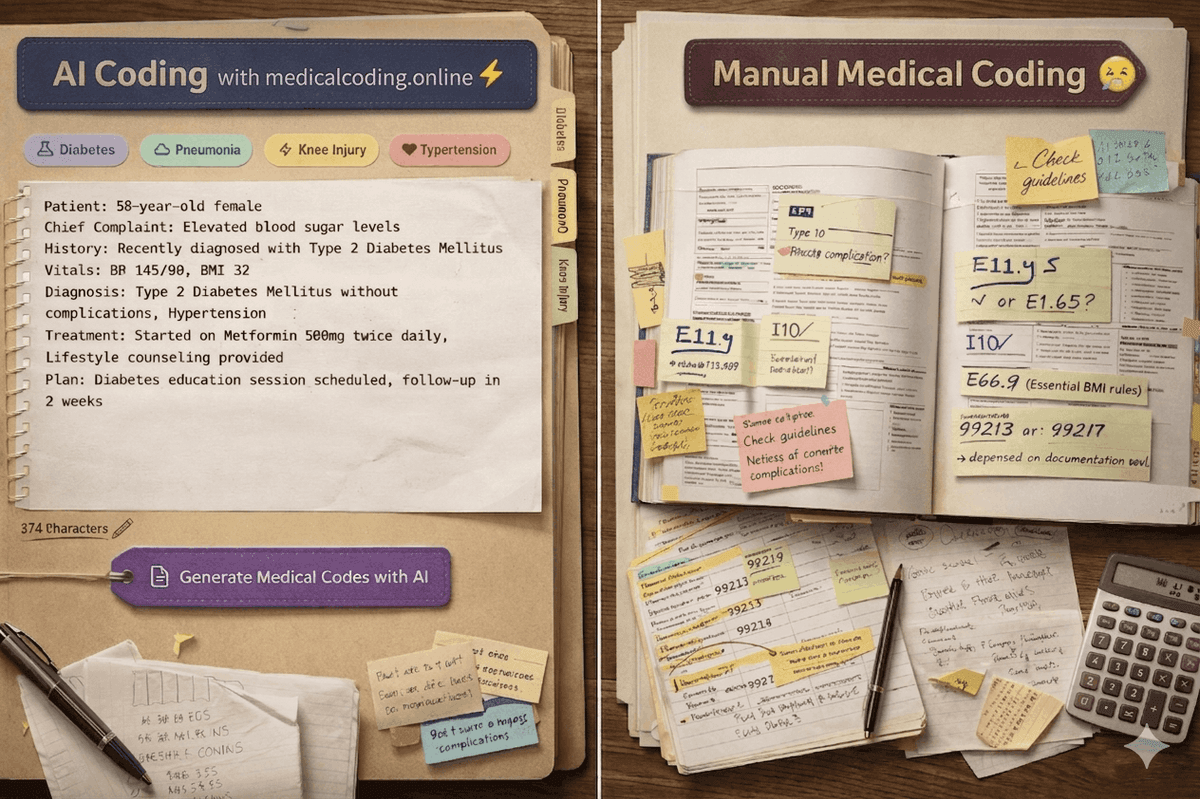
AI Coding vs. Manual Coding

Where an AI-assisted pass helps, and what it changes about the work.

TaskManual CodingMedical Coding Online
Time per case15–30 minutesSeconds
Review signalVaries by coderConfidence score per code
Denial risk detectionManual reviewAutomatic
Confidence scoresNoneEvery code
ICD-10, CPT & HCPCSSeparate lookupsAll in one
CostCoder salary + trainingFree to start
AvailabilityBusiness hours only24/7 online

Built for Every Healthcare Professional

How practices, billing companies and certified coders each use the tool.

Medical Practices & Physicians

Stop spending 15–30 minutes per chart on manual code lookups. Paste your SOAP notes and get ICD-10 and CPT suggestions in seconds.

  • Reduce after-hours documentation time
  • Catch missing codes before submission
  • No coding training required

Medical Billing Companies

Take on higher client volume without adding headcount, using AI-assisted suggestions as the first pass.

  • Process more claims per coder per day
  • Unlimited generations on the Advance plan
  • Per-code rationale to speed up review

Certified Medical Coders

Use it as a second opinion and a quality-assurance layer. Confidence scores and denial risk alerts point you at the codes worth a closer look.

  • Second-opinion validation on complex cases
  • Denial risk flags before submission
  • Supports ICD-10, CPT & HCPCS

Practice Administrators

Raise first-pass acceptance and cut the rework that follows a denial. The Clean Claim Score gives you one number to track.

  • Higher first-pass acceptance rates
  • Reduce claim denial rework costs
  • No software installation needed

Start Generating Medical Codes in Seconds

Paste a note and see the codes it supports. No account needed to try it.

Try Free: 10 Generations Per Month

Simple, Transparent Pricing

Start free. Upgrade when you need more volume.

Free

10 generations a month, all code types, confidence scores on every code. No card required.

Get started free

Paid plans

Higher monthly allowances, image upload for scanned notes, and PDF and CSV export. Advance removes the generation limit entirely.

Compare plans and pricing →

Frequently Asked Questions

What is medical coding?
Medical coding is the process of translating clinical documentation into standardised alphanumeric codes that payers use to process claims. A coder reads the note and assigns codes from three main systems used in the United States: ICD-10-CM for diagnoses, CPT for procedures and services, and HCPCS Level II for supplies, drugs and equipment. Those codes become the claim submitted to Medicare, Medicaid or a commercial insurer, so they determine both whether the claim is paid and how much.
What is the difference between ICD-10, CPT and HCPCS codes?
They answer different questions about the same encounter. ICD-10-CM codes say why the patient was seen, the diagnosis, and are maintained by the CDC and CMS with updates effective 1 October each year. CPT codes say what was done, the procedure or service, and are maintained by the American Medical Association with updates effective 1 January. HCPCS Level II covers what was supplied, including durable medical equipment, drugs administered in the office, prosthetics and ambulance services, and is maintained by CMS. A typical outpatient claim carries at least one ICD-10-CM code paired with at least one CPT code.
How do I generate medical codes with AI?
Paste the clinical note into the generator, run it, and review what comes back. The tool reads the documentation, identifies the diagnoses and procedures it finds, and returns ICD-10, CPT and HCPCS suggestions with a confidence score and a plain-English rationale for each one, plus the wording in your note it drew from. You then verify each code against the official guidelines before it goes on a claim. Your first generation needs no account, so you can see the output before deciding anything.
How accurate are the generated medical codes?
We do not publish an accuracy percentage, because we have not run a benchmark that would support one. What we do give you is the reasoning: a confidence score on every code, the wording in the note it was drawn from, and a denial-risk flag. Codes are suggestions for a qualified medical coder to verify before billing submission, never a billing decision.
What are the benefits of using AI for medical coding?
The main benefit is time. A chart that takes 15 to 30 minutes to code by hand is returned in seconds, so a coder reviews rather than starts from a blank page. Beyond speed, an AI pass is consistent across a day's work in a way human attention is not, it surfaces specificity the documentation supports but a rushed coder may miss, it suggests modifiers that are easy to forget, and it flags denial risks before submission rather than after a rejection. The rationale attached to each code is also useful for training new coders and for defending a claim in an audit. What it does not do is remove the need for a qualified coder to verify the result.
How do I find the right ICD-10 code for a diagnosis?
Start from the exact wording in the documentation, not from memory. Look the main term up in the Alphabetic Index, then confirm the code in the Tabular List, which is where the instructions live. Code to the highest level of specificity the documentation supports, since many three-character categories are not billable on their own and require a fourth, fifth or sixth character. Then follow the notes: Excludes1 means the two conditions cannot be coded together, Excludes2 means they can, and a 'use additional code' instruction means a second code is required. For example, E11.22 for type 2 diabetes with diabetic chronic kidney disease requires an additional code from N18 to identify the stage, and N18.3 itself is not billable because it needs a fifth character for stage 3a or 3b.
Why do medical claims get denied?
Most denials come from a small set of recurring problems rather than exotic ones. The common causes are a diagnosis coded with insufficient specificity, a diagnosis that does not support medical necessity for the procedure billed, a missing or incorrect modifier, code pairs that conflict with NCCI edits, services billed outside the patient's coverage or eligibility, and simple sequencing errors where the primary diagnosis is not listed first. Nearly all of these are visible before submission, which is why the generator returns a denial-risk flag and a Clean Claim Score instead of only the codes.
Will AI replace medical coders?
No, and treating it that way is how practices get into trouble. An AI tool reads documentation and proposes codes, but it does not take responsibility for the claim, cannot query a physician about ambiguous documentation, and does not know your payer's local coverage determinations. Coding is a certified, accountable role, and submitting unverified AI output is a compliance risk, not a shortcut. What changes is the shape of the work: less time spent building a code set from scratch, more spent reviewing, correcting and handling the cases that genuinely need judgement.
Is my patient data secure?
Yes. Clinical notes are sent over HTTPS, passed to our AI provider to generate the codes, and never written to our database. What we keep is the output: the codes themselves as anonymous statistics, with no note text and no link to your account, which is how we track which codes the tool produces most. We also count how many generations you have run, because that is what your monthly allowance is measured against. Nothing else from your note is retained.
What happens to a clinical note after I paste it?
It is sent over HTTPS, passed to the AI provider that generates the codes, and then it is gone. The note text is never written to our database, so there is nothing to retrieve, export or leak afterwards. We keep only the codes themselves as anonymous statistics with no link to your account, plus a count of how many generations you have run so your monthly allowance can be measured. As a matter of good practice, remove patient identifiers such as names, dates of birth and record numbers before pasting, since the coding works from the clinical content and does not need them.
Can I use this for billing submission?
The generated codes are AI suggestions for reference and educational purposes. All codes must be reviewed and verified by a qualified medical coder or healthcare professional before submitting to insurance payers.
What is the Free plan limit?
The Free plan allows 10 code generations per month at no cost. It needs a free account, which takes about 30 seconds with just an email address, and no credit card. Image upload and PDF/CSV export are on the paid plans, which start at $19/month.

Recent Blog Posts

Guides and coding changes worth knowing about

How AI-Powered Medical Coding is Revolutionizing Healthcare Documentation
Technology

How AI-Powered Medical Coding is Revolutionizing Healthcare Documentation

Medical coding has long been one of healthcare's most critical yet time-consuming tasks. Every patient visit, procedure, and diagnosis must be translated into standardized codes for billing, insurance claims, and medical records. For years, this process has relied heavily on manual effort, deep expertise, and countless hours of work. But what if there was a faster, more accurate way?

8 months ago6 min